4-Week At-Home Workout Plan: Minimal Gear, Daily Stretch
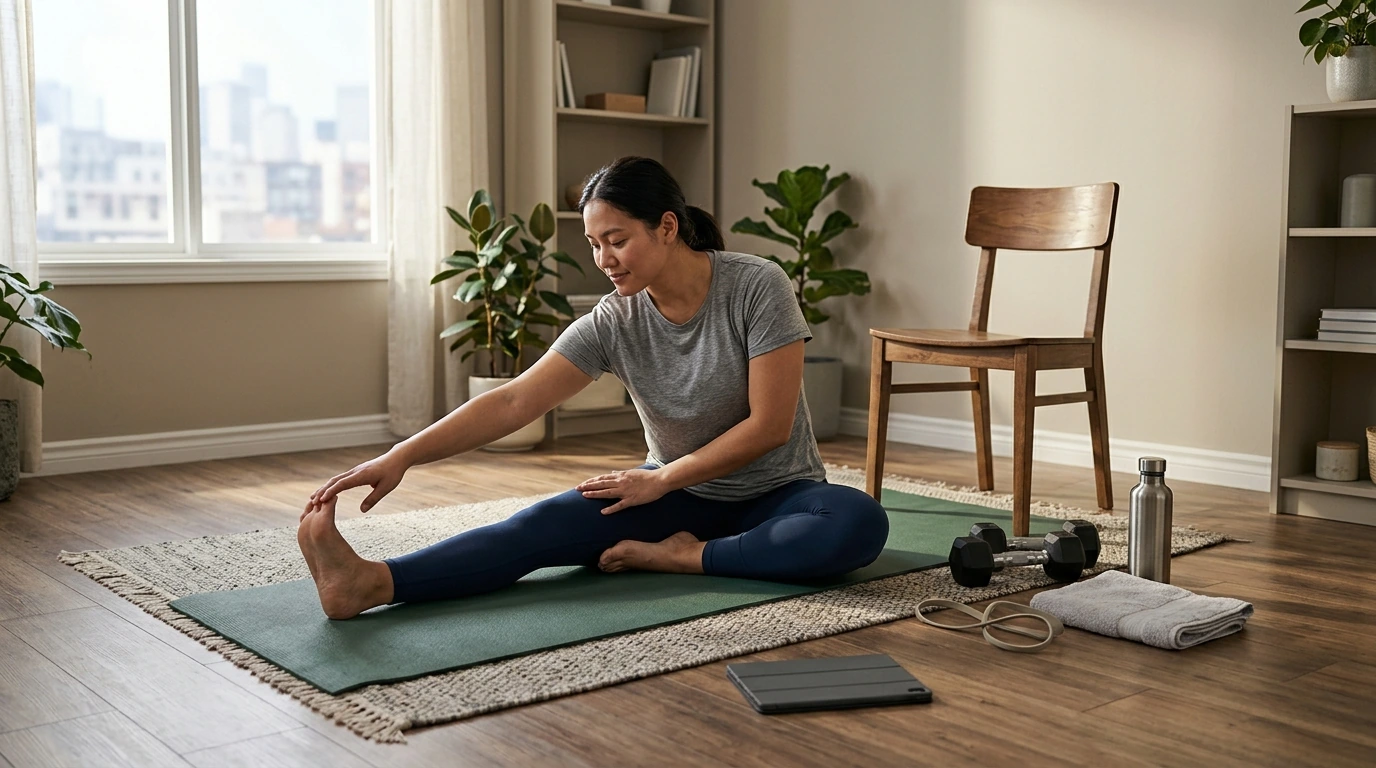
Fit at Home: A 4-Week Minimal-Equipment Workout Plan with Daily Workouts and Stretches
A structured month-long routine can make home training feel simple and repeatable: show up, follow the day’s session, and finish with a short stretch. This guide breaks down how a 4-week plan works, what “minimal equipment” realistically means, how to scale intensity safely, and how to stay consistent when space, time, and motivation fluctuate.
What a 4-week home plan is designed to do
A good four-week plan is less about perfection and more about building momentum you can repeat. With a clear daily schedule, you remove most of the “what should I do today?” friction and replace it with one job: complete the day’s focus.
- Build training consistency with a clear daily schedule (strength, cardio/conditioning, mobility, and recovery).
- Progress gradually from Week 1 to Week 4 by adjusting reps, sets, tempo, rest time, or difficulty—without needing a full gym.
- Support joint health and performance with short daily stretching and mobility work that pairs with the workout focus.
- Reduce decision fatigue: each day has a defined goal so the only task is to complete it.
For overall health benchmarks, public guidance like the CDC physical activity basics and the ACSM exercise guidelines can help you sanity-check how your weekly movement adds up.
Minimal equipment setup (and smart substitutes)
“Minimal equipment” doesn’t mean no tools—it means you can cover a lot with a few versatile items and common household stand-ins.
- Core items that cover most exercises: a yoga mat, a sturdy chair/bench, and a resistance band set or a single loop band.
- Optional add-ons for easier progression: a light-to-moderate pair of dumbbells or adjustable dumbbells, and a jump rope (if space allows).
- Household substitutes: filled backpack (weighted), water jugs (dumbbell substitute), towel (slider substitute on hard floors), stairs (step-ups).
- Space check: a 6×6 ft area is enough for most bodyweight circuits, planks, lunges, and mobility flows.
If you’re training in a small apartment, prioritize moves that stay “in place” (split squats, hinges, push-ups, rows, planks) and use time-based circuits for conditioning rather than long runs across a room.
A sample weekly schedule (repeat with progression across 4 weeks)
A practical structure is 3 strength-focused days, 2 conditioning days, 1 mobility/stability day, and 1 recovery day. Repeat the same weekly template for four weeks, then progress gradually: add one set, add 2–3 reps per set, slow the lowering phase, shorten rest, or upgrade to a harder variation.
| Day | Focus | Workout (examples) | Stretch & Mobility (5–10 min) |
|---|---|---|---|
| Day 1 | Strength (Lower body + core) | Squat variation, hip hinge (RDL/good-morning), reverse lunge, glute bridge, plank series | Hip flexor stretch, hamstring stretch, calf stretch, gentle spinal rotations |
| Day 2 | Conditioning (Low-impact) | Intervals: fast march/step-ups/shadow boxing + core finisher | Ankles (knee-to-wall), quad stretch, deep breathing in child’s pose |
| Day 3 | Strength (Upper body) | Push-up variation, row (band/backpack), overhead press (band), triceps/shoulder accessory, dead bug | Chest doorway stretch, lat stretch, neck/upper trap release |
| Day 4 | Mobility + stability | Controlled articular rotations, glute med work, balance drills, light core | Longer holds: hips, T-spine opener, hamstrings |
| Day 5 | Strength (Full body) | Circuit: squat + press, hinge + row, split squat, carry (backpack), side plank | Hip stretch, pec stretch, calf/ankle mobility |
| Day 6 | Conditioning (Moderate) | Circuit: step-ups, mountain climbers (modified), band pulls, squat to chair, short finisher | Lower back decompression, figure-4 stretch, gentle forward fold |
| Day 7 | Recovery | Easy walk or light yoga flow | Full-body stretch: hips, calves, hamstrings, chest, shoulders |
Daily stretching priorities that pay off fast: hips, ankles, thoracic spine (upper back rotation/extension), chest/shoulders, and hamstrings—especially if you sit a lot.
How to scale the plan to your level (beginner to advanced)
- Beginner scaling: shorten sessions (15–25 minutes), use chair support for squats/lunges, incline push-ups, longer rest periods.
- Intermediate scaling: add a set, reduce rest, introduce unilateral work (split squats, single-leg RDL), add band resistance.
- Advanced scaling: slow tempo (3–5 seconds down), pause reps, add density (more work in the same time), progress to harder variations.
- Use an effort gauge: finish most sets with about 2–3 reps “in reserve” so form stays clean and joints don’t get beat up.
Daily warm-up and cooldown that actually gets used
Recovery, consistency, and results tracking
Downloadable plan option: daily workouts and stretches in one place
- Look for clear daily structure, minimal equipment options, and straightforward progression across the four weeks.
- Product to consider: Fit at Home: 4-Week Workout Plan (PDF download).
- If you like pairing routines with an at-home accountability vibe, you can also add family-friendly structure with Stronger Together: Family Bonding Pack on recovery days or evenings.
FAQ
How long should each at-home workout take on a 4-week plan?
Most sessions land around 20–45 minutes depending on your warm-up, rest times, and how many sets you do. On busy days, a “minimum effective” version can be 5 minutes to warm up, 10–15 minutes of circuits, and 3–5 minutes of stretching.
Do stretches need to be done every day?
Brief daily mobility (5–10 minutes) helps keep joints moving well and can reduce stiffness from sitting. Save longer stretching sessions for recovery days, but try to hit high-value areas often: hips, ankles, T-spine, chest/shoulders, and hamstrings.
Can a minimal-equipment plan still build strength?
Yes—progressive overload can come from more reps/sets, slower tempo, longer range of motion, less rest, or adding resistance with bands and a weighted backpack. When you can easily exceed your target reps with clean form, it’s a good cue to increase difficulty or add load.












Leave a comment